Download File
Please provide your contact information below to proceed with the download. We only use this to enhance your experience and offer relevant updates.

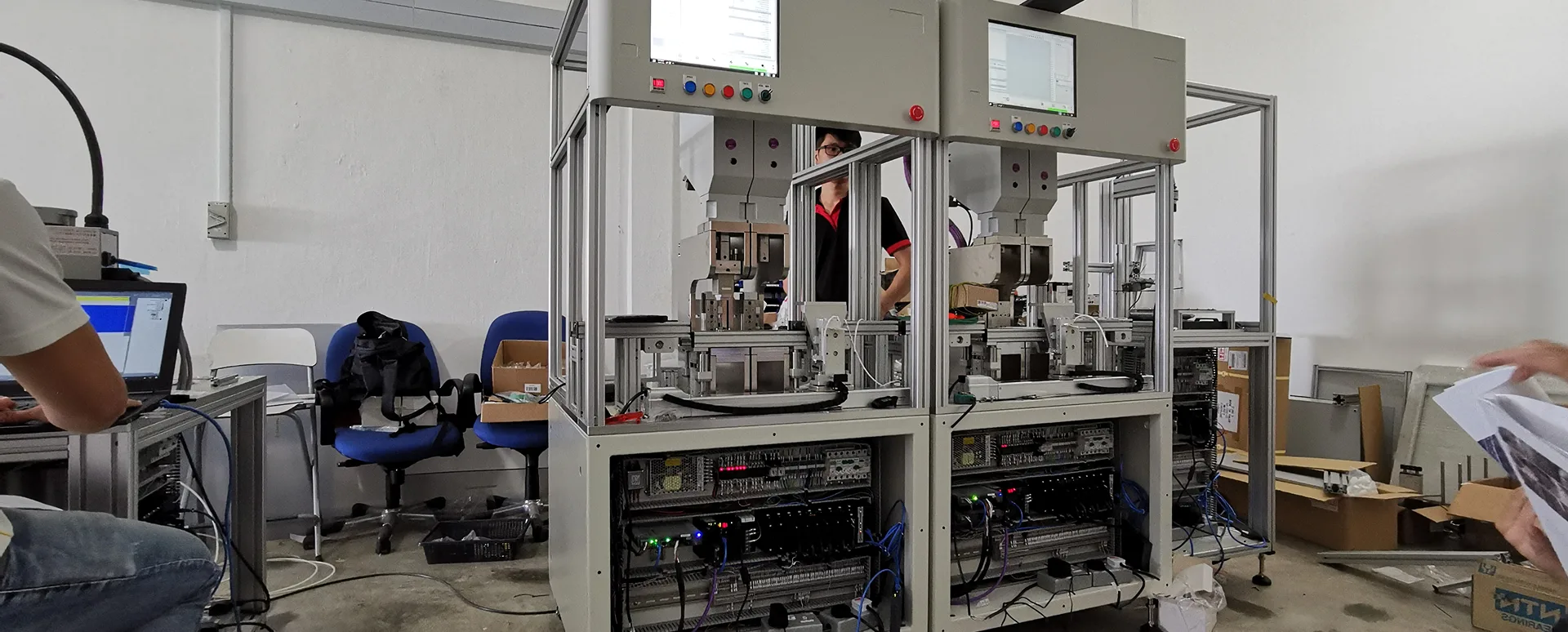
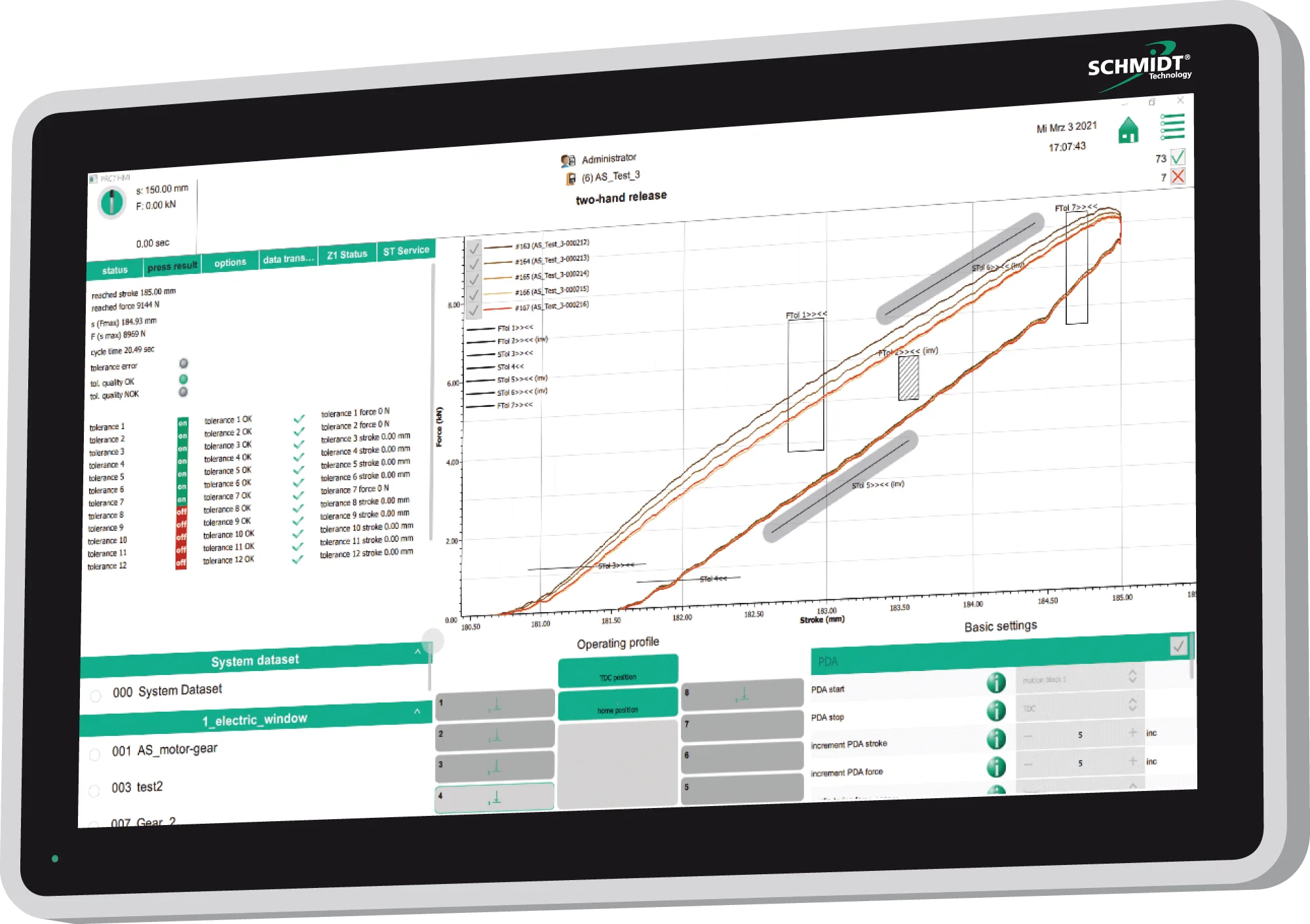
In a pressing or assembly process, achieving the correct force is often essential for producing a consistent result. Too little force may leave a component incompletely seated, while excessive force can damage components, tooling or the finished product.
Press Force Monitoring is a process-control method used to measure the force generated during a press cycle and determine whether it falls within an acceptable range. Manufacturers can identify abnormal press cycles and provide an OK or NOK result before the part continues to the next process by monitoring force values during production, .
Unlike more advanced force-displacement monitoring systems, Press Force Monitoring focuses primarily on the force generated during the pressing operation. This makes it a practical solution for applications where force itself provides a reliable indication of process quality.
A typical Press Force Monitoring system uses a force sensor or load cell to measure the mechanical load generated during each press cycle.
The basic process involves several stages:
| Process | What Happens |
| Force Generation | The press or actuator applies force to the component during the pressing operation. |
| Force Measurement | A force sensor measures the mechanical load and converts it into an electrical signal. |
| Signal Processing | A signal amplifier or controller processes the sensor signal and converts it into engineering units such as Newtons (N) or kilonewtons (kN). |
| Force Evaluation | The controller compares the measured force against programmed limits or process criteria. |
| OK/NOK Decision | The cycle is classified as OK when the force meets the required conditions, or NOK when the criteria are not met. |
| Machine Response | When integrated with machine controls, the system can trigger an alarm, prevent the next sequence, or initiate a reject or segregation process. |
The parameters monitored depend on the system configuration and the type of process being controlled.
Common parameters include:
| Parameter | What It Indicates |
| Maximum or peak force | The highest force reached during the cycle |
| Minimum force | Whether sufficient load or contact was achieved |
| Force threshold | Whether force reached a predefined level |
| Force trend over time | How force changes during the press cycle |
| Force at selected stages | Force behaviour at important process points |
| Cycle OK/NOK | Whether the cycle meets the programmed criteria |
A force-only system can evaluate force values directly. However, parameters involving physical position require an additional displacement or position signal. For example, force over stroke becomes part of force-displacement monitoring rather than force-only monitoring.
This distinction is important when selecting a monitoring approach. Not every pressing application requires a complete force-displacement curve.
Pressing processes can appear successful from the outside even when the required mechanical load has not been achieved. A component may be partially inserted, insufficiently compressed or subjected to an abnormal load without being immediately obvious through visual inspection.
Press Force Monitoring provides a way to verify that the expected pressing load was actually present.
It can help identify conditions such as:
Some problems, such as cracks or incorrect components, may also produce a detectable force signature. However, this needs to be validated for the specific application rather than assumed.
The main value is therefore not simply measuring force. It is using force as a process-quality indicator.
Press Force Monitoring is not limited to one particular press technology.
Depending on the available sensor and monitoring or controller system, it can be applied to:
The important consideration is whether the equipment can accommodate a suitable force measurement and monitoring system.
This means manufacturers can consider Press Force Monitoring across different machine configurations instead of treating it as a solution limited to a specific type of press.
Press Force Monitoring is suitable when force itself is a meaningful indicator of process quality.
Typical applications include:
It can be used across automotive, electronics, semiconductor and electromechanical, medical, appliance and general manufacturing applications. However, the suitability of the technology should be determined by the process rather than simply by the industry.
For example, two manufacturers in the same industry may have completely different requirements. One process may be reliably verified through force alone, while another may require both force and position information.
One of the most important parts of implementing Press Force Monitoring is determining what constitutes an acceptable result.
The limits should not simply be selected based on a theoretical force value. A more reliable approach is to evaluate representative production samples.
A typical validation process involves:
1. Test known-good parts
Run a representative group of parts to understand the normal force variation of the process.
2. Understand process variation
Look at how force changes between acceptable parts rather than assuming every cycle will produce exactly the same value.
3. Introduce known defects where practical
Known defect conditions can help determine whether the monitoring system can distinguish acceptable and abnormal cycles.
4. Establish engineering limits
Set upper and lower limits with enough margin to accommodate normal production variation while still identifying meaningful defects.
5. Validate the limits
Confirm the settings during process validation and review them when tooling, material or other important process conditions change.
This approach helps prevent limits from being set either too tightly, which could create unnecessary NOK results, or too loosely, which could allow defects to pass.
The controller evaluates the measured force against the programmed criteria.
A cycle may be classified as abnormal if, for example:
The controller can then classify the cycle as NOK. When connected to the machine control system, the NOK signal can be used to trigger an alarm, lock the next cycle or initiate a reject or segregation sequence.
Whether the press can be stopped during movement depends on the machine design, control architecture and safety concept. Press Force Monitoring should therefore not be treated as a replacement for the machine’s safety system.
A typical system can include several components working together:
| Component | Main Function |
| Press or actuator | Generates the pressing force |
| Force sensor/load cell | Measures mechanical load |
| Signal amplifier/controller | Processes and evaluates the sensor signal |
| PLC or machine-control interface | Communicates the result with machine controls |
| HMI/software | Displays or manages monitoring information |
| Data storage/MES connection | Supports process data and traceability where configured |
Safety devices and guarding remain separate essential parts of the press workstation.
The exact configuration depends on the machine, process requirements and level of monitoring required.
Successful implementation depends on more than selecting a force sensor.
The sensor capacity and overload protection should match the application. The mechanical load path should also be stable, and the sensor should be installed where it represents the actual process force.
Another important consideration is validation. Monitoring limits should be established using real production samples and should reflect normal process variation.
It is also important to understand the limitations of force-only monitoring. If two different defects generate similar force signatures, force alone may not provide enough information to distinguish them. In critical assembly applications, combining force with position monitoring may therefore provide a stronger process-control method.
The key question is not simply whether your industry uses pressing equipment. The more important question is whether force provides a reliable indication of your specific process result.
If the quality of an operation depends on achieving a particular load, preventing excessive force or confirming sufficient contact, Press Force Monitoring may provide a practical way to monitor the process in real time.
For more complex applications, additional information such as position or displacement may be required. The monitoring method should therefore be selected based on the process characteristics, expected defects and level of quality control required.
Press Force Monitoring is a practical process-control technology that measures the force generated during a pressing operation and evaluates it against defined criteria. It can help manufacturers identify abnormal cycles, prevent common pressing defects and establish more consistent process control.
Its strength is its straightforward approach: measure the force, evaluate the result and respond when the process moves outside the acceptable range.
However, successful implementation requires appropriate sensor selection, stable mechanical load measurement and properly validated limits. For processes where force alone does not provide enough information, adding position or displacement measurement can provide deeper process insight.
Ultimately, the right monitoring system depends on the process being controlled, not simply the machine or industry in which it is used
Talk to our team to discuss your application, explore suitable options, or arrange a demo. Our Team is ready to help.
Press Force Monitoring is a process-control method that measures the force generated during a pressing operation and evaluates it against predefined criteria. It can provide an OK/NOK result for each press cycle, helping manufacturers identify abnormal processes before the part moves to the next operation.
A force sensor or load cell measures the mechanical load during the press cycle. The signal is processed by a controller, converted into engineering units such as N or kN, and compared with programmed limits. The system then determines whether the cycle meets the required criteria and can communicate the result to the machine controls.
Depending on the application, it can help identify insufficient force, excessive force, missing contact, incomplete seating, excessive friction, jamming, misalignment and other abnormalities that produce a repeatable change in the force signature.
Detection capability should be validated for the specific application rather than assumed for every type of defect.
Common parameters include:
Parameters involving physical position, such as force at a specific position or force over stroke, require an additional position or displacement signal.
It can be applied to various press technologies, including:
The key requirement is that a suitable force sensor and monitoring/controller system can be properly integrated with the equipment.
